
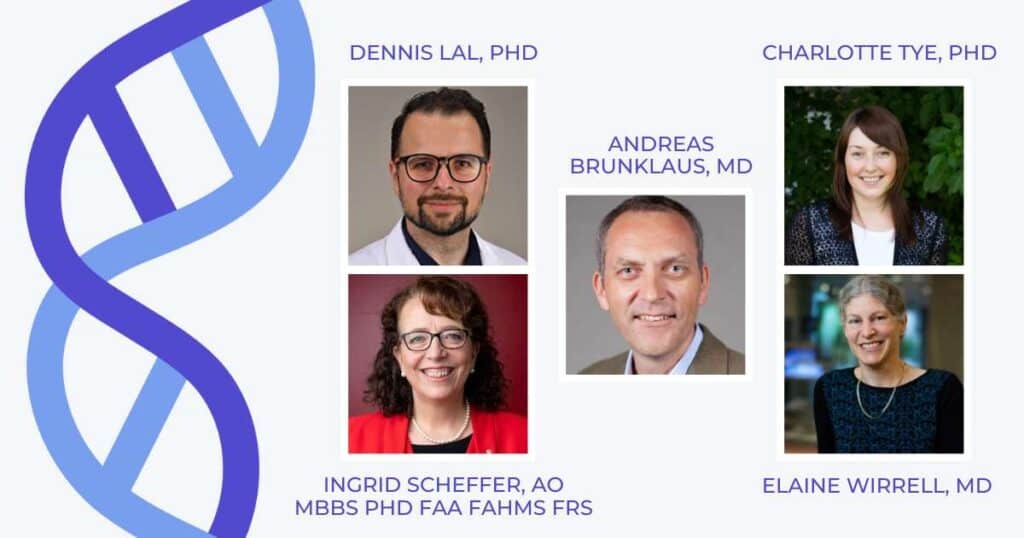
Professor Andreas Brunklaus, MD, MRCPCH- Royal Hospital for Children Glasgow
Charlotte Tye, PhD- King’s College London
Elaine Wirrell, MD- Mayo Clinic
Laureate Professor Ingrid Scheffer AO MBBS PhD FAA FAHMS FRS- University of Melbourne, Austin Health and Royal Children’s Hospital, Florey and Murdoch Children’s Research Institutes, Melbourne, Australia
Dennis Lal, PhD- UT Health Houston
Predicting Dravet syndrome outcomes: harnessing natural history data and biomarker discovery to inform early diagnosis and targeted intervention
Clinical Research Grant- $249,989 over 2 years
Summary from the Investigators:
SCN1A-related epilepsies are a group of seizure disorders caused by changes in the SCN1A gene. The most serious form is Dravet syndrome (DS), which usually starts in a baby’s first year of life. Children and adults with DS have frequent and difficult-to-control seizures, often experience long seizures that require emergency care, and face challenges with learning, behavior, and movement. The risk of early death is also higher. At the milder end is genetic epilepsy with febrile seizures plus (GEFS+), where seizures are often linked to fevers and children usually develop normally in terms of learning and thinking. Knowing early on whether a child will develop DS, or a milder form is incredibly important. If we can identify children at risk soon after seizures begin, we may be able to start new treatments such as genetic therapies before serious developmental problems appear. However, many doctors still lack confidence in making a DS diagnosis and miss the opportunity for prompt treatment and existing prediction tools are not accurate enough to guide enrollment into genetic therapy trials safely. To confidently diagnose and treat early, we require (1) A reliable way to predict the likely course of the condition; and (2) Accurate ways to measure if treatments are making a real difference in a child’s daily life.
Our project focuses on both goals. First, we will build and test a prediction tool using detailed information from over 400 people with SCN1A-related epilepsies. This information comes from four major research groups, including the high-quality long-term SCN1A Horizons and ENVISION natural history studies. These studies have gathered standardised details on seizures, treatments, behavior, learning, movement, quality of life, and healthcare needs. Hundreds of affected families world-wide have voluntarily contributed to this effort and the collected data will help to achieve these important research goals. Second, we will find the best ways to measure results (‘outcome measures’), such as tests of thinking and learning skills, and brain wave recordings (EEGs) that can act as biomarkers (signs in your body that can be measured, like blood pressure or heart rate). These will help doctors monitor the condition and see if new treatments are working.
Our research will progress in stages, over the course of two years. In the first year, we will carefully organise and combine the information from all study sites and set up methods for collecting clinical data and EEGs. In the second year, we will test and confirm which outcome measures and biomarkers are most reliable and finalise our prediction tool. The requested funding will largely be used to train future epilepsy scientists including a neurosciences PhD to collect, harmonise and interpret the clinical and investigation data and a genetic data analysis expert to develop the prediction tool. This research will allow doctors to diagnose Dravet syndrome as early as possible and give families the chance to consider life-changing treatments at the right time. It will also give researchers better tools to measure progress, helping ensure that new therapies truly improve symptoms, learning, and quality of life for individuals affected by SCN1A-related epilepsies. The findings from this study also have the potential to help the development of similar prediction tools for other genetic epilepsies.
About the Investigators:
Professor Andreas Brunklaus is a consultant paediatric neurologist at the Royal Hospital for Children, Glasgow and honorary professor at the College of Medical, Veterinary and Life Sciences, University of Glasgow. He trained at the Charité Medical School, Humboldt University Berlin, Germany and completed his child neurology training at Great Ormond Street Hospital in London and the Royal Hospital for Children in Glasgow. He obtained his MD from the University of Glasgow and has an ongoing research interest in epilepsy genetics, in particular sodium channel disorders. He is an international expert in SCN1A-related epilepsies and Dravet syndrome and is the author of several key publications. He leads international research collaborations developing novel diagnostic tools in epilepsy genetics and is the UK chief investigator for “SCN1A Horizons – A natural history study of SCN1A-related epilepsies in the United Kingdom”.
He is lead of the Scottish Paediatric Epilepsy Network, has numerous national and international advisory board positions, is chair of the International League Against Epilepsy (ILAE) Genetics Commission and editorial board member of the European Journal of Paediatric Neurology.
Dr. Elaine Wirrell is the Chair and Professor of Child Neurology and Program Director of Child and Adolescent Neurology at the Mayo Clinic in Rochester, Minnesota. She completed medical school at the University of British Columbia and her Pediatric Neurology training at Dalhousie University in Halifax, Nova Scotia. She is the current Chair of the Pediatrics Commission and past Co-Chair of the Nosology and Status Epilepticus Task Force and the Pediatric Medical Therapies Task Force of the International League Against Epilepsy. She serves as the Co-Editor-in-Chief of Epilepsy.com and is on the Medical Advisory Board for the Dravet Syndrome Foundation and the Lennox-Gastaut Foundation. Dr. Wirrell’s main research interests are in early onset, medically intractable epilepsies including developmental and epileptic encephalopathies and epidemiology and comorbidities of pediatric epilepsy. She is the recipient of the 2021 Kiffin-Penry Award from the American Epilepsy Society and the 2016 Distinguished Clinician award from Mayo Clinic.
Dr. Charlotte Tye is a developmental psychologist and Senior Lecturer at King’s College London. Her research focuses on early brain and behavioural development in rare genetic epilepsies. She leads national cohort studies in tuberous sclerosis complex and early-onset epilepsy, with expertise in infant EEG biomarkers and longitudinal outcome measurement. Charlotte also works closely with patient organisations to co-design accessible, family-focused research.
Laureate Professor Ingrid Scheffer AO MBBS PhD FRACP FAES FAHMS FAA FRS is a physician-scientist whose work as a paediatric neurologist and epileptologist at the University of Melbourne, Florey and Murdoch Institutes, Australia, has led epilepsy genetics research over three decades. In collaboration with Professor Samuel Berkovic and molecular geneticists, they identified the first epilepsy gene and many genes subsequently. She led the first major International League Against Epilepsy revision of the classification of epilepsies in 28 years. She has published over 720 papers and is passionate about improving outcomes for patients and families through innovative translational science. She was the second president of the Australian Academy of Health and Medical Sciences. She was co-recipient of the Australian Prime Minister’s Prize for Science in 2014, and was also awarded the 2012 L’Oréal-UNESCO Woman in Science Laureate in Paris and, in 2018, was elected to the Royal Society of London. In 2025, she was awarded the Outstanding Female Researcher medal by the Australian Academy of Health and Medical Sciences.
Dr. Dennis Lal has held various positions throughout his career and received numerous honors and awards for his research contributions. He has been involved in large-scale genomics research consortia and serves as a scientific advisor for several rare genetic epilepsy family foundations. In addition, he has led bioinformatic analysis groups in major epilepsy genomic research projects. Dr. Lal is an active member of professional societies, including the American Society for Human Genetics and the International League against Epilepsy Genetics Consortium.
His contributions to science include the discovery of disease genes associated with epilepsy, studies on epilepsy copy number variants, studies on somatic genetic variants in human brain tissue, and polygenic risk, and investigations into the genetics of neurodevelopmental disorders. Dr. Lal and his team have developed various computational methods, tools, and online resources to aid in interpreting and translating genetic variants. He has successfully guided several BS, MS, and Ph.D. candidates in receiving their degrees and established several educational initiatives such as the ‘precision medicine fellowship’ and several bioinformatic and clinical genetics application workshops to educate early career and established neurologists in genetics and precision medicine.
Overall, Dr. Dennis Lal is an accomplished researcher and educator in genetics and clinical neurogenetics, devoted to enhancing our comprehension of brain disorders through genomic research and its application in clinical care. As the Director of the Center for Neurogenetics at UTHealth Houston, he is continuing his ongoing research program and, clinically, is facilitating the utilization of genetic tests and advanced genetic test interpretation at the neurological institute to establish gene-informed precision medicine clinical trials.