Dravet Syndrome Foundation (DSF) us dedicated to funding research that will move new treatments forward and improve the quality of life for those living with Dravet syndrome (DS). Sometimes research progress can feel slow or incremental, but DSF works closely with the patient community and experts in research to identify gaps in knowledge where DSF funding can have the biggest impact over time. Every research investment is made with a long-term goal in mind: accelerating understanding, improving care, and driving toward improved outcomes for people living with DS and related epilepsies.
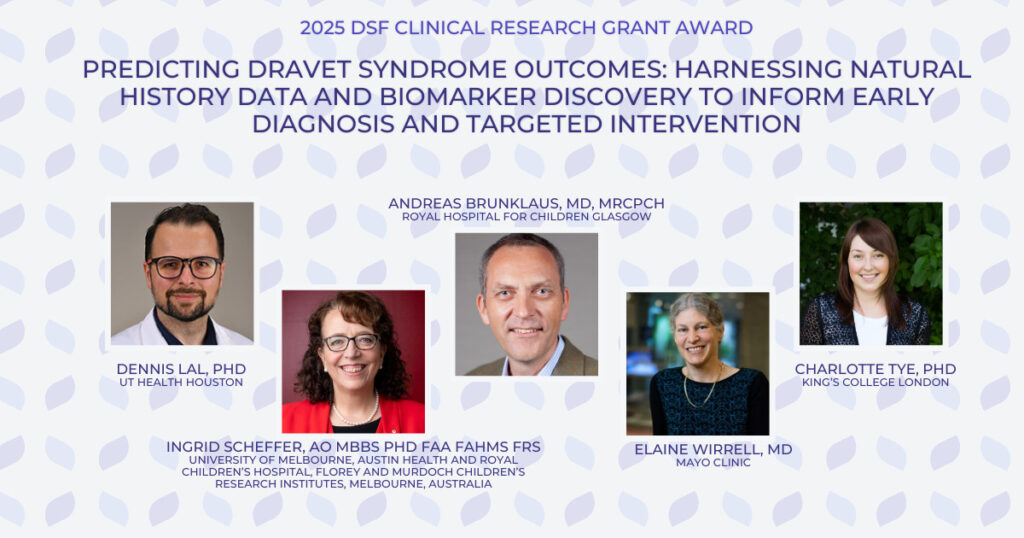
One of our most recently funded projects—“Predicting Dravet Syndrome Outcomes: Harnessing Natural History Data and Biomarker Discovery to Inform Early Diagnosis and Targeted Intervention”—is a powerful example of how strategic funding, collaboration, and patient involvement in research over time can build momentum and deliver increasingly meaningful impact. This project, led by Professor Andreas Brunklaus at Royal Hospital for Children Glasgow, brings together patient-level data from multiple unique academic and industry-led research efforts and includes collaborators in the UK, US, and Australia.
Building on a Strong Scientific Foundation
This newly funded work builds directly on prior research published in 2022 in the scientific journal Neurology (https://doi.org/10.1212/wnl.0000000000200028), which introduced a predictive model for SCN1A-related epilepsies. That study demonstrated that combining genetic variant data with clinical features can improve the ability to anticipate disease trajectory. The SCN1A Prediction Model emerged as a useful clinical tool from this work (available at scn1a-prediction-model.lalresearchgroup.org). This online resource allows clinicians and researchers to input variant-specific information and brief clinical information to better understand the likelihood that a particular SCN1A missense variant is associated with DS versus other SCN1A-related epilepsies (Generalized Epilepsy with Febrile Seizures Plus, GEFS+).
Now, with this new DSF funding, the team is strengthening and expanding this model—refining its predictive power by incorporating richer datasets, additional biomarkers, and more comprehensive natural history data. The goal is that this will enable earlier and more accurate diagnosis, better-informed prognosis, and ultimately more targeted intervention strategies.
Need a reminder about what a ‘missense’ mutation is? Want to learn more about the different mutation types that lead to DS? Unsure about the spectrum of disorders that are caused by SCN1A mutations? Our Genetics of DS webpage details more about the causes of DS and the classes of mutations that have been identified in patients.
A Full-Circle Investment in SCN1A Research
This project also reflects DSF’s long-standing commitment to advancing the science surrounding DS. In 2016, DSF funded Dr. Dennis Lal to better understand SCN1A variants and their role in disease. That work on variant interpretation laid groundwork for the predictive modeling efforts, and Dr. Lal remains one of the collaborative researchers involved in this recently funded project. It is a meaningful example of how early-stage research funding can catalyze advances that continue to build nearly a decade later. When we invest in researchers, we are not just funding a single project, we are helping to build scientific careers and research programs that remain focused on solving the complexities of DS.
The Power of Natural History Data
A key strength of this new project is its integration of robust natural history data. In a recent blog post, we discussed the importance of ongoing efforts to expand Natural History Data for DS.
DSF previously supported SCN1A Horizons: A Natural History Study of SCN1A-Related Epilepsies in the United Kingdom, again underlining DSF’s commitment to funding impactful research that supports near- and long-term advancements. The longitudinal clinical data collected through the SCN1A Horizons study are now being used to inform and strengthen the predictive model and to identify potential biomarkers related to clinical progression of symptoms. Families who dedicated time and energy to participate in the SCN1A Horizons study are continuing to drive progress—even after their initial involvement.
This research effort also expands beyond just the cohort of patients in the United Kingdom- the project is robustly collaborative, with researchers in the US and Australia also contributing data from patients to be incorporated. In addition, data from the Envision Natural History Study sponsored by Encoded Therapeutics will also be incorporated into the analysis. This collaboration between academic researchers and industry partners represents the kind of cross-sector cooperation that accelerates meaningful advances for the patient community.
By combining datasets across studies, researchers can increase statistical power, validate findings across independent cohorts, and extract deeper insights than any single dataset could provide alone.
Honoring the Contributions of Families
Participation in a long-term Natural History Study requires extraordinary commitment from patients and caregivers. Clinic visits, questionnaires, medical record sharing, daily seizure diaries all add up to significant amounts of time and energy contributed to advancing research- from families that are often already shouldering a lot of other impacts to daily life from DS. Ensuring that the data collected are used to their fullest potential is both a scientific priority and a responsibility to the community.
By integrating data from multiple natural history efforts, this project maximizes the impact of families’ participation. Each contribution helps refine predictive tools that may one day enable rapid diagnosis, more accurate counseling about disease course, more personalized clinical decision-making, and improved designs for clinical trials of novel therapies.
Moving Towards the Future of Precision Medicine in Dravet Syndrome
We have all probably heard the warning about making comparisons: “No two individuals with Dravet syndrome are alike.” It is true, that DS is a spectrum in terms of the severity of symptoms that appear in each patient, and furthermore, DS exists along a further spectrum of disorders caused by genetic variants in the same gene- SCN1A. The ability to predict outcomes earlier and more accurately based on genetic and clinical information is a critical step towards being ready to employ precision medicine in the clinic. And that is more relevant than ever before as new, genetically-targeted therapies are being testing in clinical studies.
This new DSF-funded project represents continuation of investments in long-term research trajectories that build and strengthen existing tools, take advantage of international, cross-sector collaboration, and amplify patient and family contributions all with the goal of improving patient care.
Progress in rare disease research is rarely the result of one study alone. It is built layer by layer—grant by grant, dataset by dataset, collaboration by collaboration. DSF is proud to support research that not only advances science today, but also builds the infrastructure for collaborative, rapid, and more targeted advances for the future.