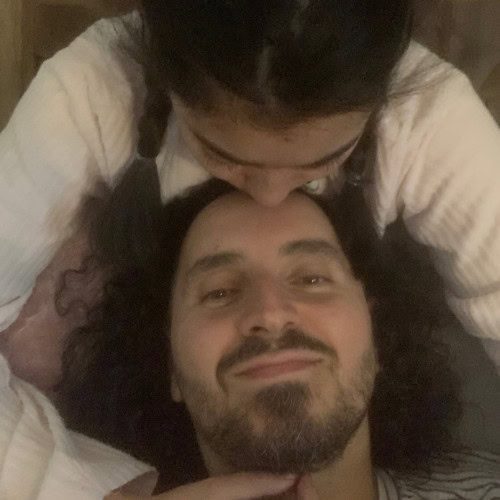
Adel Bounif
France
Can you share your journey of receiving your loved one's diagnosis of Dravet syndrome?
My daughter is called Manel. She was a baby when she had her first seizure at 8 months. The seizure lasted nearly one hour. At first, doctors didn’t say that it was epilepsy but one month later, she had another seizure and then two more seizures two weeks after. After that, she had many seizures each day and then we knew something was going wrong. After many emergency room visits, hospital admissions, EEG’s, blood tests and many medication, Manel was officially diagnosed with Dravet Syndrome, a rare and severe form of epilepsy with a mutation in the SCN1A gene. This mutation is most often not inherited from the parents but is considered as «de novo » which means that the mutation happens randomly.
What are some of the biggest challenges you’ve faced as a caregiver?
Manel has developmental delays, intellectual disability, language delays, movement and balance issues and mood disorders. Unfortunately, there is no cure. Because of her delays, Manel couldn’t stay longer in a classical school because the gap the other children was too large. Furthermore, the teachers were not trained to first aid medical rescue and there was also a lack of specialised assistants for disabled children. This is the reason why we registered our daughter in a specialised center for disabled children.
How do you manage the stress and emotional strain that comes with caregiving?
As a dad and caregiver, I felt useless being unable to find a cure for my daughter. I really needed to share my story in order to express my sorrow and my pain. Words and rhymes came naturally to my mind. This was obvious that poetry would be my survival weapon. This was the start of a long struggle which aims to raise awareness among the media, the government and the pharmaceutical labs in order to develop research so that the disease could be diagnosed at an early stage. For me, Poetry is a different way to speak about sickness with light, positive and soothing words, rather than medical words that can be difficult to understand. My mother tongue is French but writing in English could carry my books across the world. I have also published a comic book for children in order to explain epilepsy and Dravet syndrome with easy words to understand. Lately, my comic book has been awarded with a literary prize! I hope it will help to stop stigma and dispel myths linked to epilepsy.